Meara (00:00)
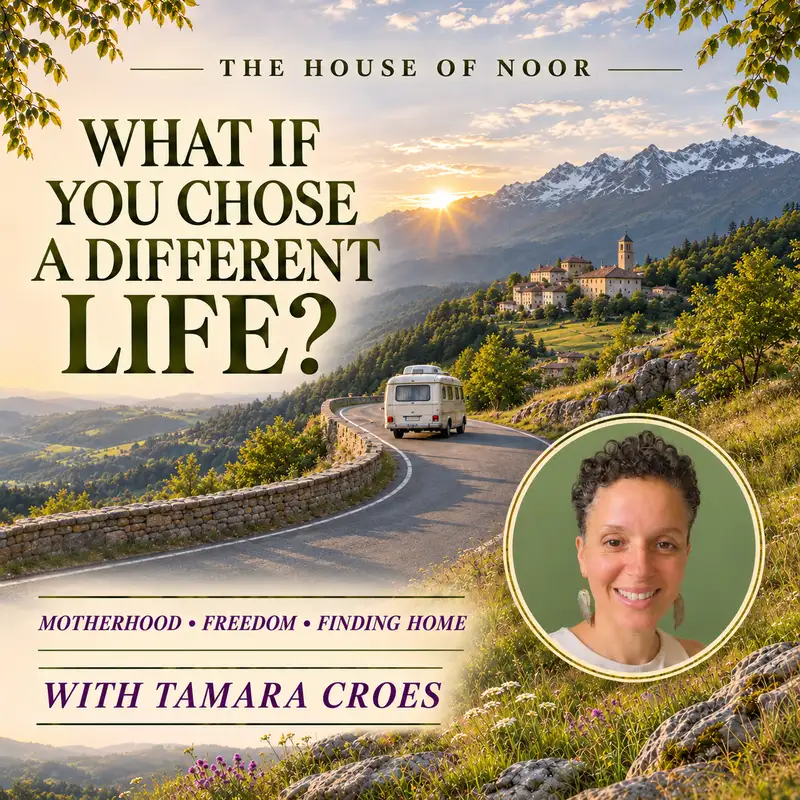
If you could start your life over tomorrow, with no expectations from family, society, or anyone else, would you choose the life you are living right now? It's something we're thinking about because so much of what we do comes from what we've always known. My guest today, Tamara Crows, is a mother of five and a glamma whose family has traveled, lived in different countries, and is now building a life in South America. Today we're talking about family, the choices we make.
And what happens when we begin to question the way we've been doing things? I'm Mira and this is the House of Noor. Tamara, welcome. I'm so glad you're here.
Tamara Croes (00:38)
I'm so happy to be on your show.
Meara (00:40)
Before we jump into everything that you're building today, I would like for you to take me back to the beginning. just an overview of where you grew up and what family was like for you back then.
Tamara Croes (00:51)
Oof, well,
Meara (00:52)
Yeah.
Tamara Croes (00:54)
family picture was very different back then. So I grew up in, if I think you want to say in a relatively big family considering the Western standards, I have two younger sisters and a younger brother. So we were a family of four kids. But my circumstances in which I grew up were not that pleasant.
there was a lot of abuse going on in different categories and it took me until I was eighteen, finishing I think you can say high school in the US kind of, that I
ran away from home. I was already seeing my now husband for nine months. And together we we yeah we started life. Bang bam and that has been already twenty no yeah twenty-five years ago. Sorry I had to get the number right. so yeah
Grew up a big family. I had a good connection with my my grandma back in the days. She passed away years ago though. that was that was really nice. but the house, the home, that was
Not that nice
Meara (02:03)
when you were growing up, what did you imagine your life? what did you imagine that your life would look like when you became an adult?
Tamara Croes (02:10)
good question. Okay, so I've always been fascinated by airplanes and the sky and flying and everything. So when I was very, very young, I wanted to be a flight attendant. That changed over the years of becoming a pilot.
And that dream got crushed when I was I think about 16, 17 years old, when they told me that that that I couldn't afford that. so I s started searching in another direction. And then I found aerospace engineering, which was you know close enough to getting to understand how everything works, and I could still
touch a flame from here on now once in a while. Yeah, that's just me. In the end I think that has been for so that's how that that has basically been the the thing that I held on to during those first 18 years of my life is getting out and getting to study and and figuring out how to wait how to get away from home I wanna say, even though it sounds really bad, but that was really
Meara (03:09)
Yeah.
Tamara Croes (03:10)
what was going on. So
That was my main focus. Other than that, I always thought I would never have children because of the bad experience that I was having. Not because of my brothers or sisters, but because of course of how my parents were raising us. And depends on how you look at it.
that was the day.
When I met my now husband, I was 17 years old. I was in my last year of high school. I I things started to change back then. So that was actually the first year that I was really starting to feel like, okay, life can be different. And I noticed, yeah, that was really the feeling that I have. Before that, I didn't have much. I just go day by day and enjoyed being away from home because.
Any anywhere else was safe and home wasn't. but
Meara (03:57)
Yeah.
Tamara Croes (03:57)
then it started to change like okay, there's more to life than what I've seen so far. And it turned out for the good, I can see.
Meara (04:07)
Yeah, it seems like your career path stayed the same with engineering. Did you en really enjoy what you were doing or did you eventually realize that you wanted something completely different or?
Tamara Croes (04:17)
I really enjoyed what I was doing up until I think so it so when I started in the end 'cause it still took some time before I started university, that thing stayed. I had a little bit of a break after high school, so it took me two years. So I think I started studying when I was nineteen at the university. I already had my first son back then and in the first month of of starting university I got pregnant of our second
First girl, second baby. So I started studying
with kids, which is a whole adventure on its own. I mean, can you imagine walking around there with all the guys? And
Meara (04:52)
Yeah. Yeah, it is.
Tamara Croes (04:54)
then you are there with a big ass belly and then the the the stares you get. It's insane. I made a really good
Meara (05:00)
Yeah.
Tamara Croes (05:00)
connection with one of the female teachers back then. She really was advocating for me. not that it was that I was experiencing anything negative or things like that, but at some point, for example, when the baby was born and I was breastfeeding, they created like a room, they
they were not using at the moment of time. Well they put a sign on it that that's for breastfeeding and I was that was literally my private my private environment of where I could go. So yeah, fun things that you do experience when you go through that.
Meara (05:26)
Yeah.
No, I completely align with you on that. I had my firstborn when I was in the middle of school as well. And then I went back. I had a siz she was my second child in school and it was my first caesarean. And I ended up finishing
Tamara Croes (05:38)
Yeah.
Meara (05:39)
the week a week later and graduating. And they also let me bring her in because I too was nursing. So I understand exactly what she went through. And it is a whole nother ball game. Yeah. Yeah.
Tamara Croes (05:50)
Yes. Yes. Yes, it is. And and
it's also that you know everybody is doing all the all the the parties every week or every month. I don't know how many how many there are with the different things, and then you are going home
Meara (06:05)
Yeah.
Tamara Croes (06:06)
back to your family and and figure out how to do the studying in between in between the chaotic life
Meara (06:12)
Okay, yeah.
Tamara Croes (06:12)
of of of family, you know, so that's
Two completely different
Meara (06:16)
Right.
Tamara Croes (06:16)
things. Don't regret it. But but
Meara (06:19)
It is. It is.
Tamara Croes (06:21)
I I I would still say though, try not to do it with school. It's very challenging. So it's a lot. It's a lot.
Meara (06:27)
Yeah, that's a lot. It's a lot. So
you've gone you've gone through school, started building your career and living the life that you thought you were supposed to live, but somewhere along the way things started changing. Was there a particular moment for you when, you know, that aha moment when you realized I want to do something different? Or was it something that happened gradually for you?
Tamara Croes (06:49)
I think it's more gradually. So many many
Meara (06:52)
Mm-hmm.
Tamara Croes (06:52)
things happened o over the years that passed. so like I said, studying at some point figuring out that I tried to do my masters for example. I did it tr I started over
Meara (07:05)
well.
Tamara Croes (07:06)
three times, three different masters, and I couldn't finish it, I couldn't focus on it anymore. And at some point it it dawned on me, like I'm not even doing this for me anymore. Because back
Meara (07:15)
Yeah.
Tamara Croes (07:16)
back back in the days in my the the focus at at home was study good, get good grades. But you know that that that stigma was brought on to me and that's what I carried on. And at some
Meara (07:23)
Mm-hmm. Sure. Yeah.
Tamara Croes (07:29)
point after ten years of walking in in in in the university, I finally realized, hey I'm not even doing it for me anymore.
Meara (07:38)
Yeah.
Tamara Croes (07:39)
I'm I'm
Meara (07:39)
Yeah.
Tamara Croes (07:39)
doing this for somebody, some for my for the little girl inside of me that that thinks that she still has to prove something. You don't have to prove anything anymore. You're really living your life. So that was one thing where things changed. I was working by then, I think in that last year of
where that transition happened, I was I started working at a really for me a cool company was an aerospace company where they made parts for satellites, which, you know, for me was like the playground to walk around with. But I still love everything really to aerospace. So
but that's when things started started to change, like like okay, what do I want to do? I was still working when I was at the job. a year later they had reorganizations, they actually laid me off, but I kind of stayed another year because I started, you know, there was still work to be done and I freelanced it so that then the construction got a little different, less hours, but in the end for me monthly was
still the same so I was en enjoying that and in the meantime I love I still do love baking creating and I've started to see okay let's see if I can do this and so so sell pies. it's hard work
Meara (08:56)
It is,
Tamara Croes (08:58)
that one year where I was freelancing I was selling up hides, my final piece that I did was a wedding cake, which I was I was deadly nervous for that moment. I had to bring
Meara (09:09)
Yeah, that would have been.
Tamara Croes (09:11)
it all the way across country, you can say. I mean for me that's an an hour drive because Netherlands isn't that big, but still
can you imagine?
Meara (09:20)
Well when you're traveling with a cake,
yeah, that's a lot. No pressure.
Tamara Croes (09:22)
Yeah, I had the three pieces and and
and I remember we got lost and then we went over bridges and it was too hobbly and I was just like no you can't can't make this up and then I had to put it together there at the wedding, stacking it up, putting I think what they had I made roses, you know I was like this
Meara (09:45)
Yeah. That would have been like never again.
Tamara Croes (09:47)
But it was a break.
No, that's also true. I was I was like, okay, there was a fun but it it takes a lot of time and even though I I loved it, everybody loved it, they always like the way it tastes or the way it looks like, but it it's just a lot of work and what you get in between for in in rever in return for currency, it's you know, it's not a lot. So
Meara (10:09)
Right. Right. So
it sounds like you were starting to babble in things that you were interested in doing. Yeah.
Tamara Croes (10:12)
That was where yes, correct. But
I was not confident enough. So once that year of freelancing also stopped, I tried to figure out how to continue, I couldn't, so I went back into the workforce.
it's not bad.
Meara (10:32)
Yeah.
Tamara Croes (10:33)
Learn more, learn to talk more about another subject. Because that's the cool thing about aerospace engineering. You learn a d a way of thinking, a way of solving, and that is something you can apply to any job. And that's also the reason why in
Meara (10:46)
Yes.
Tamara Croes (10:46)
the end I wasn't too sad when I had to go for aerospace engineering because that was also what they sold us. And it's not a bad sell. I experienced it. I was able to do different jobs, completely different
say that. Different so one is aerospace, the other one is oil and gas,
Meara (11:05)
Different areas.
Tamara Croes (11:07)
you know, diff different industries, huh? Completely different industries and I was still
Meara (11:09)
Yeah. Yes.
Tamara Croes (11:11)
I was still able to do what I was I could do. And so
Meara (11:15)
Yeah.
Tamara Croes (11:16)
that helped me a lot in in developing further as a person, I think I would say.
And while at the while at the job, at some point I got the opportunity to go to the US because they were implementing a certain software. And that's where the whole an all-water journey started. and that's when things really started to change for us as a family, I would say. I think that was a point
Meara (11:44)
Yeah.
Tamara Croes (11:44)
where things really started to change. Yes.
Meara (11:47)
Yeah, now this is something I've really been looking forward to talking with you about because we're both raising children and different stages of life. We're both grandmothers now. And I think that's such an interesting place to be because you get to see motherhood from a completely different perspective. So
Tamara Croes (12:04)
Yes.
Meara (12:05)
I guess my question for you is what's been the biggest difference for you between raising your older children and raising your younger ones?
Tamara Croes (12:15)
The biggest difference is how
Meara (12:16)
Or is there one?
Tamara Croes (12:18)
how there's tons. That's why I'm like I'm trying to create one single sentence. But it's the biggest difference is we are now living more on our terms.
Meara (12:33)
Yeah.
Tamara Croes (12:34)
We are actively deciding.
What we want to do. Not everything is perfect yet. Don't get me wrong. It's
Meara (12:43)
Right, right.
Tamara Croes (12:45)
not even perfection. It's not we're not there where we want to be. But
Meara (12:49)
Mm-hmm.
Tamara Croes (12:50)
we are living towards that and making those necessary steps to make it happen. We're not doing the in Dutch you say hush bump, which translates to home husband.
Home tree animals. So you know the common way of going about life. you go to school, you start a family, you buy a house and all that, you know, the standard steps. We did that.
Meara (13:18)
Mm-hmm.
Tamara Croes (13:18)
We didn't like it. We found out during the way we didn't like it, I have to be honest, because we didn't knew any better.
But now we don't do it anymore. And we I mean we don't do it unconsciously anymore. I think that's a very good
Meara (13:34)
Yeah.
Tamara Croes (13:34)
thing to point out. so that is that is that is the complete difference in raising the kids because my first two
We were ra raising them with a mindset that at some point in life they need to go stand on their own, go out of the house, and yeah, just go live life. And now, with the second batch, we were more like, you know, we are gonna do this as a family. We are creating a business so that you guys can pick that up once you are off of
Meara (14:03)
Yes.
Tamara Croes (14:04)
off
common sense or knowledge to
Meara (14:06)
Yes.
Tamara Croes (14:07)
do that because whenever that happens for somebody is whenever it happens, no we're not sticking a an age on that. So that is that is the the
Meara (14:16)
Right.
Tamara Croes (14:16)
biggest difference.
Meara (14:19)
It is. It is. I
agree a hundred percent. My two elders or the oldest two the adults, it was all about society. You know, I was the soccer
Tamara Croes (14:28)
Yeah.
Meara (14:28)
coach, the soccer mom that here, there, they had friends, we weren't comfortable, they never spent the night at anybody else anybody's house except for there was just one friend they had that was brother and sister. So it was the
Tamara Croes (14:40)
Yeah.
Meara (14:40)
same house and I was really close with the mom. But, you know, everything else was we're gonna eat this because
They promote it. We're gonna do this because of this. It's all it was all society based. And,
Tamara Croes (14:51)
Yes.
Meara (14:52)
you know, I have high expectations of you. I'm expecting you to go to college or okay, fine, not college, maybe community college. And and I feel like I put some we put so much pressure on them that
Tamara Croes (15:02)
Mm-hmm.
Meara (15:02)
it just kind of I don't know. I don't I don't feel like they got what they needed from me as a mother, but I was also early twenties, so they were also teaching me how to be mom. And now that I have my second batch.
Like you say, your batch. we have the elders and the littles, and we're teaching them the same concept of you know, you don't have to go to college to be successful. We want you to do what you're wanting to do, what you enjoy doing, and being able to make a living off of that. So, you know, it's just a whole different concept raising these children.
the legacy we would love to leave for our children is self-sustainability where you are able to live off the land, able to navigate life, living around the, you know, what everyone wants you to be in this world. And I don't want them to be like everyone else. I want them to be their own person, make their own decisions and their own choices.
Meara (15:56)
Now, another thing we have in common is that we're both educating our children outside of the traditional school system. I homeschool mine and I always enjoy hearing how other families approach learning because everybody does things a little different, and I'm gonna be honest, sometimes I need a little help. what first led you toward unschooling with your younger children?
Tamara Croes (16:19)
it happened when we were in Aruba. So after our US adventure we went to Aruba. I went to Aruba pregnant with our third. And when we had to put our two oldest in school there
For my son it went easy. He's always been a yeah, easy learner. He didn't like school but it was easy for him. but for my daughter it's a little bit different, you know. She just needs more time to learn in the end, that's what we learned. But anyways, and okay, so we went of course from the Netherlands to the US and then to Aruba and the school system in Aruba is kind of like the same as it is in the Netherlands. But of course in the US when they went to school there, for let's say
I think they in the end enjoyed approximately eight months of school there. But still, going to Aruba, in the Nellands you work with a system that
is very annoying and it places you already in a lane, I want to say, and if you want to divert from that lane, it's almost impossible. And that is what happened for my for our daughter. That she was placed in a lane back in the Netherlands. Then she went to the US where I really saw the potential that she was given and the that effort that she was making and in making I mean really want to go for it and do her utmost past. So knowing that she has that energy, that fire in her
And then coming back to coming to Aruba and fighting for her to go into an another lane basically and then just being denied. No, because back then in the Netherlands, she was put in this lane, and this is where she stays. Not only that, she had to do one year from she had to start over, you know, she lost and then she lost a year. So that was already the friction going on, like, okay, this is I don't, we don't like this. Okay, that was that was that was I think the onset it. But maybe it already happened way before because lots of other things happened during school.
Kids, my experience, my husband's experience, which is completely different. And that's a whole other book that you can write about. And
Meara (18:17)
Yeah.
Tamara Croes (18:18)
you know, so then the third one gets worn. And then I was really like, And back then we were an Aruba, so he was like, yeah, I don't want him to go in the school system, you know. So when he started to turn one or two, I started to also talk about that with my husband.
And he was really like, okay, I would what then? Like I don't know. I just know that I don't want this, you know. Like back then I don't even think I looked anything up about homeschooling nothing. I just had a feeling like,
Meara (18:44)
well.
Tamara Croes (18:44)
no, it's not it doesn't feel okay. And
Meara (18:47)
Yeah.
Tamara Croes (18:48)
then of course we had experienced COVID on Aruba. that brought a whole other level of
eye-opening events for ourselves and then when we had our fort five months later we traveled back to Europe again and that's when the that's when the whole journey of nomadic living really started and
I think before that already we decided that he's not going to school. We just didn't at that point figure we didn't know how to do that because we were still in Aruba, but once we went nomadic it was easy. So but that's a little bit of a story of how that came to life. of the reason why we did not want to put the kids into school. Yeah. I think
Meara (19:34)
I feel like a lot of it sounds like a lot of the school systems are the same, but has their own set of rules on how they do things, it sounds like across
Tamara Croes (19:43)
Yeah.
Meara (19:43)
across the world, as far as, you know, well, this is where your kids gonna be and this is how they're gonna be. And same with us, we feel like they were just starting to fail our kids. My one of our elders has a learning disability. I too
Tamara Croes (19:53)
Yeah.
Meara (19:54)
had a learning disability. And so, you know, even though my child was on the IEP, they were still failing her. And
Even though the IAP is set in place for a child to get the services that are needed, and I and especially they were doing online school towards the end. I really respect everything that these early intervention specialists were doing because they were just, you know, above and beyond trying to help her, give her extra time, even taking time out of their day to be with her, to help her. But in the end,
Tamara Croes (20:21)
Mm-hmm.
Meara (20:22)
school carries on, right? And if your
Tamara Croes (20:24)
Yeah.
Meara (20:25)
child's still stuck and they can't catch up, how does that even work? How do you bridge the gap?
So
I had decided to pull my six year old because we were sitting in front of the computer for six hours a day. Six hours a day, a six-year-old, a five-year-old. And I said, this is absolutely
Tamara Croes (20:36)
Yeah, it's that's insane.
Meara (20:39)
ridiculous. If I'm gonna sit here for six hours a day, I'm gonna do it myself. I don't know how I'm gonna do it. I don't know where the willpower is gonna come from for me to do it, but I'm gonna do it. So I pulled her and then two weeks later, I'm like, that's it. My elders, they're getting pulled also. And here we are, knees deep in this homeschooling. Some days I'm just like today, I was like, I don't, I don't wanna do it. But
I was like, well, what do you want to do? And I never ask them really what they want to do because we have a set schedule for how we do things. But we just
Tamara Croes (21:04)
Okay.
Meara (21:04)
made today fun and my five year old actually knows the entire alphabet now. And like that's a huge accomplishment for her. So
but yeah, so it's it has definitely worked out for our family. How does it look for you like an ordinary day for your family with learning with learning? Your unschooling, right?
Tamara Croes (21:23)
and
yes, so I'm not following you know I have to be honest, not following any strict schedule.
Meara (21:30)
Yeah.
Tamara Croes (21:32)
our mornings are really easy, really relaxed. everybody
Meara (21:35)
Mm-hmm.
Tamara Croes (21:36)
wakes up whenever they need to wake up. That's one I think the biggest changes.
Meara (21:38)
Yeah. Yep.
Tamara Croes (21:41)
And
especially now because we have the youngest who is now she's almost turning two, but she still sleeps with me. So she wakes up with me. It takes an hour before she finally like, Okay, yes, now I'm gonna go out of bath and then I'm already, you I'm already now on my phone doing whatever I can do. But
Meara (21:56)
Yeah.
Tamara Croes (21:57)
Yeah, I make breakfast, you know, we and then currently now so the third one is almost eight years old. He has been starting on equations, you know, just one plus one, but then up until a certain but that's another fun thing. Can I share? So a couple weeks ago I've been made I've been writing down the equations for him and I used a site that was that was good, that it helped me in just not that I
Have to think which equations to write, you know. I can just copy it and then write it down. I still write it because I want him to write so that's and I don't have a printer, so anyways. and but I was I wanted I want him to chat to challenge him a little bit more, you know, and I wanted to do that on speed, but I couldn't.
the why'd you say that? well anyway the site I was using wasn't flexible enough in what I wanted with my equations. So
Meara (22:50)
to do.
Tamara Croes (22:51)
I've created a equation generator. You can find it on my website, it's for free.
Yes, so look, that's how my mind goes. If I need something and I can't find it, or maybe it's there, but I find the hurdle of getting it or find the cost too high, I'll try to figure out how to do it myself. So, anyways, that's that. So he's into equations and free promotion. And and
And now I mean he is interested, I mean he knows the alphabet, but he doesn't like writing. So the reading part isn't going as smoothly. I've also I've learned from other or not learned, I've learned online from other parents that have boys that it takes some time for boys to get there, but once there it goes past, so I'm not overly concerned.
so he knows a couple of words, but I'm also there thinking, okay, how is the best way to get him to like it? Because he loves to play Minecraft. So can I somehow combine that? But he just doesn't like writing, so I need to figure out how to approach that. And then we
Meara (23:50)
Make it more fun.
Tamara Croes (23:50)
have our five-year-old girl who is currently now just learning writing the numbers. And the alphabet I think she can say, but I can put a letter in front of her and can be any letter. So that's that's where
Meara (24:04)
Yeah.
Tamara Croes (24:04)
we're
I'm very relaxed about it. I can I think I can say
Meara (24:09)
Yeah.
Tamara Croes (24:10)
because in the end they will not re the s the thing is what we do differently so two three months ago I think in the meantime I don't know how fast time goes sometimes
We came up with doing something else during breakfast. they come up with a topic that they want to know about. We find the first one how it started was me trying to figure out how to explain it to them because we were talking about clouds. We were talking about clouds, because we see a beautiful mountain outside and we saw clouds. And anyway, that was the subject. So I was trying to figure it out by watching a video myself to explain it even better of and things like that. And that's when I was like, you know what? This is a lot of time for me to figure things out and then to explain to them. Yes, it's fun, but
We can also just watch the video together, you know. I can listen to it as well, what they're learning at that moment in time. And then if I think like, this is interesting to keep on talking about, we'll ask questions. And that's what we don't know every morning. I mean they pick up a topic and they watch it. And if it's interesting, we keep on going on further. and now we're getting into a point that they really have to think what they want to know. Because, you know, there's so much there on the internet. I really don't have to do a lot for them to learn, apart from the fact that we're also, you know
we've done a lot of traveling we've seen things that our elders still haven't seen so I have to say even so
Meara (25:27)
Yeah.
Tamara Croes (25:27)
that's the difference so yeah
Meara (25:30)
Yeah. I also find it that a
lot of questions my kids have, I'm also learning alongside them. Things I'm just kinda like, okay. Yeah. after living in different
Tamara Croes (25:39)
You know what we were talking
Meara (25:40)
places, go ahead.
Tamara Croes (25:43)
Y yeah, you know what we were talking about last couple of days? How do do chicks eat in an egg? That was a discussion.
And I still couldn't find a good
Meara (25:55)
Interesting.
Tamara Croes (25:55)
video about it that explained it well enough because there's videos on how the chicks grow.
Meara (26:00)
Yeah.
Tamara Croes (26:00)
You know, when the chick is out of the egg, then they know what they're eating. But what happens in the egg? So if somebody finds something about that or knows it, you know, feel free to share because the kids want to know.
Meara (26:11)
Let us know. Yeah.
I love these questions that these kids asked. after
Tamara Croes (26:16)
Okay. Yes, but yeah, it brings it brings funny
conversations.
Meara (26:23)
it really does. And conversations you never thought you would go, places you would go. after living in different places, what does home mean to you now?
Tamara Croes (26:36)
Being together. And that's really hard
Meara (26:38)
Yeah.
Tamara Croes (26:39)
to say because I don't feel complete at the moment. So because our
Meara (26:43)
Yeah.
Tamara Croes (26:43)
authors are in Europe, we are in South America. but that is how home feels to me at least personally. And also I think for the younger kids, because they do miss their big brother and sister and their niece. Yes, they're niece. so
Meara (26:58)
Yeah.
Tamara Croes (27:00)
It doesn't take away the fact that we wanna have a home base where we can all come together and things like that. But really the word home is not a physical place, it's not a physical building, nothing. It's really us being together.
Meara (27:15)
Yeah.
Yeah. I've just recently discovered that myself as well. You've purchased land now in South America and you're building another chapter of your life there. I wanted to say what made you decide that that's where you wanted to settle, but I guess the question is this where you wanting to settle?
Tamara Croes (27:33)
We don't know. That's the honest
Meara (27:35)
Yeah.
Tamara Croes (27:36)
question. So well we feel good about where we are right now. we're going to build what we can build and see how it feels like. And to be honest, we already are thinking for something else in the future. but for now this is okay. and we go we yeah, we go with whatever life's throws at us.
Meara (27:56)
I love it.
Tamara Croes (27:57)
So I can't say that this is final that's my honest answer.
Meara (28:03)
Yeah. I think when people hear about some someone traveling, leaving the traditional career or living differently, it's easy to picture a life without all of the usual pressures, but we all have still we all still have responsibilities, right? They're just different ones. has your idea of freedom changed now that you're actually living some of these things you once dreamed about?
Tamara Croes (28:29)
yeah, for sure. So like you
Meara (28:33)
Yeah.
Tamara Croes (28:33)
said, the different responsibilities, there's different decisions that you need to make. you're so used to when you have a house, whether you own it or you rent it, that you go back to one place after something has happened, that's what you go to. But when you don't have that anymore, y
You don't have it anymore. So you need to think you need to think differently of how you settle somewhere if even if it's for a week, a month or whatever you choose to. we don't do many how do you say that? I mean we don't travel out a week or anything like that. we have kids. It's just it's not sustainable for us as a family to constantly be moving. It's not nice for the kids. They need a little bit of period to p
they I do as well, you know, to wind down because the searching takes time, where you're gonna stay, that it's a whole different aspect of traveling and you know living basically. So
Meara (29:32)
Yeah, it always
seems like you have to be one step ahead with everything. Like before you move to the next spot, you're almost thinking about how
Tamara Croes (29:38)
yes.
Meara (29:39)
the next adventure is gonna hap or start rather. do you ever have
Tamara Croes (29:41)
Yes. Yes.
Meara (29:43)
days where you question your decisions?
Tamara Croes (29:49)
no, not questioning.
Meara (29:49)
About having moved.
Tamara Croes (29:52)
No,
Meara (29:52)
Yeah.
Tamara Croes (29:52)
not really. I think the biggest thing is, like I said already, that I just really miss
my two other kids and my grandbaby at the moment. That is I think the biggest and but that's also the biggest force that keeps me going. So it's both ways. I miss them being near to us, but I also know that what we're doing, we're doing also for them. It doesn't just because they're adults and out of the house doesn't mean that it changed. I mean for me and for my two as well of course. But that's I think the biggest. But regretting, no.
learned a lot. Learned a lot of the people that are with us on this journey or not, mostly not. And yeah, keeping the circle small, I think that's what's something that came out of it. As well
Meara (30:34)
Yeah.
Tamara Croes (30:35)
unexpectedly, but yeah, that's what happens.
Meara (30:39)
Well,
Tamara, I want to hear more about everything that you're creating now. We've just talked about your life, how you grew up, you know, and where you are now. And because you have you have several different projects I see going on through com is it Commenda de Croz? Is that how you say it? Am I saying it right? Commenda
Tamara Croes (30:56)
Caminda de cruz.
Meara (31:00)
di Croz. First tell me about the name and what does it mean?
Tamara Croes (31:06)
Okay, the name comes from a saying in Papimentu. So Papimento is a language that they talk about, talk on a couple of Caribbean islands, Rubat, Bonaire, Ciracao, and you will find different dialects from actually other countries as well. That's what we're experiencing, but that's that that's another topic. and it means so the way I write it, because now if you would write it out, Cruz is our family name.
But the saying is actually cruise where you write cruise C R U Z, like it's a cross, you know? And the saying
Meara (31:36)
Good. Okay.
Tamara Croes (31:37)
is basically it's a hard, a hard life, a hard road. That is what it actually means. And what we want it to mean is see how life can be. It doesn't always have to be that hard. And in the end, every
less comfortable road is a lesson in life, you know? So we changed the cruz to our family name cruz so that it still says community cruz, but and the meaning behind is more uplifting and empowering and positive than the actual saying. Yes?
Meara (32:08)
Yeah. Yeah.
You have so many interesting things happening right now under Comunda di Cruz on your website from your
Tamara Croes (32:17)
Yes.
Meara (32:17)
camper setups to personal sessions and construction. How do all of those pieces fit together for you? And what's the heart behind basically everything that you're building on there?
Tamara Croes (32:29)
The heart behind it everything is basically freedom, but I'm in a different jacket, I would say. So
comes to the to the R Vita motorhome Roman Roots camper we have we own a camper in Europe and it's now sitting there standing there in a gorge I would say and not moving and so we want to I we want others to experience camper life we say camper but I have to say motorhome life as well and that's why I will be we'll be putting that up for rent I think the agenda can now be opened somewhere next
I want to say April.
so that's that's for that boam. And then for example, with the infinite scanner that I'm building, which is a software tool.
it's for it's freedom. I wanna actually say in the end
working towards your own finances because once you know a little bit of how to trade you increase your own financial structure, you you have more currency to work with. So that is a tool where it can help you out for that part. And then what else do we have? Ooh, we have the tribe, which is an idea that came to me over the past things that I that I've experienced myself is a platform that I'm envisioning because it
Don't exist yet, of different people who have different kinds of experiences of taking a life differently, of taking different steps, like you, like yourself, homeschooling the kids, you know, the stories that are behind it, the questions that other parents might have, or not even parents, maybe parents to be, or anybody else that could have had, that they might not be, they maybe find it online.
But maybe they have different kinds of questions and they're afraid to ask that question. I want to have an environment where you're not afraid to ask any question and where the conversation is there and anybody can in the end also look it up again. That is something that it we don't have with the current platform. Everybody is in their own silo, which is of course logic because you have your own expertise. And I want to bring those different kinds of expertise of life. Life.
living life experiences. I don't know what else to call it. I want to bring that in one and because I miss that. I'm I I have certain questions about s sometimes very specific things and I cannot just ask it because of scrutiny that you sometimes you can have on platforms, on the social platforms.
Meara (35:04)
Yes.
Tamara Croes (35:06)
That's what I want to give to try. That's yeah.
Meara (35:10)
Yeah.
So it sounds like you're basically creating a community as well where it's a
Tamara Croes (35:15)
Yes.
Meara (35:15)
safe space for people to come and ask questions and not be, like you said, scrutinized or belittled or questioned
Tamara Croes (35:19)
Yeah.
Meara (35:22)
about your questions. I mean,
Tamara Croes (35:24)
Yes.
Meara (35:25)
no question is a dumb question, no question is well, you don't need to ask that. Everyone's at different stages of life and we all need to understand that.
Tamara Croes (35:32)
Yes.
Meara (35:33)
so it sounds like your website is a collection of things.
that you have come up with ideas to better, help better others, in different areas of life,
Tamara Croes (35:45)
Yes.
Meara (35:46)
due to the life that you have lived as a nomad and a mother and a grandmother and so that's really Yeah. Yeah. Yeah.
Tamara Croes (35:52)
All the different labels that you can put on. Yeah, but that's really
it. that's also something, if I can add, something that I've been bowing over the past months because I was trying to figure out how to who am I and how do I share whatever how do I share all the things and and
Shepherd shoot, sorry. I did I wanted to go with us. I had a thought and it just went away. my goodness.
But yeah, so I've been battling with who am I supposed to be. And the thing is I'm I'm everything that you see is just touching a different part of me. And I cannot for myself just focus on one thing just because apparently that's the way to do things. No, I it I do multiple things. Yes, I still only have two hands, which can be very annoying because somehow the kids think you have eight because you they ask you three things and you're doing
One thing and then they say, like, yeah, what about the other thing? I'm like, really? I'm two hands, but okay, sidetrack.
Meara (37:04)
Yeah.
Tamara Croes (37:07)
that's how my mind goes.
Meara (37:09)
Yeah.
Tamara Croes (37:10)
So everything that you see on the website, and probably even more, because I haven't come so far that I could do the other things that I have in mind. And will everything
Meara (37:20)
Yeah.
Tamara Croes (37:21)
work? I don't know, but I don't want it to be there in my mind anymore, just there and don't.
Meara (37:26)
Right.
So are some things on your website up and actually running where people can join and do things or is this just still a concept or?
Tamara Croes (37:35)
Okay.
Yeah, so there are two things there that are up and running.
so it's business to business, I want to say, which is rice construction. it I know the name throws off thinking it is about only construction, but there's actually a little behind it.
the communication between the different silos sometimes just don't work.
So I've come up with a surface where I'm saying I can be, you know, your voice between the departments,
So that's one thing. The second one is personal one-on-one, which is deep dive with Tamara. And there is actually where I would like to invite people who are on crossroads. So at crossroads, I think that's the way you say it in English correctly. At a crossroad. At a crossroad, yes.
Meara (38:15)
Yeah.
Tamara Croes (38:16)
And yeah, because in because in Dutch it's so different, so it feels weird to say it in English.
okay and that is where I want to sit with you, have a conversation of of yeah, your life and whatever actually feels good for you at that moment in time to talk about
As a society, as you grow around people, sometimes you have certain ideas, and that's something that I have experienced with my university buddies, is that at some point I started to change, I started to see things differently.
And they didn't. And that's perfectly fine. At that moment in time I was really angry about it, but now I understand it's fine because they're not on that, yeah. they're not walking that path you are. But it gets very lonely.
Meara (39:06)
Right.
Tamara Croes (39:07)
It's got very lonely if you're thinking differently or you want to approach things differently, you don't know where those people are, or you even think that why am I supposed to do that? It's not what everybody else is doing. And that's so wrong to be walking around that for so long. So I want to create that space, I want to create that.
mirror for the person. Like here you can talk whatever is going on in your mind because nothing is too crazy or nothing is crazy what other people or other people might think that. No it's not. It's what you feel, see that you want to make a change about in your own life. And that's what is important. And
Meara (39:38)
Right.
Tamara Croes (39:39)
that's that's what that space is about.
Meara (39:42)
Right. Well, Tamara, before we wrap up, there's just one last thing that I would love to ask you. And that is when your children and grandchildren look back on their lives with you, what do you hope that they'll remember the most?
Tamara Croes (39:55)
The laughter, being together, eating together, funny things together, just being together.
Meara (40:01)
Yeah. Just being in that moment.
Tamara Croes (40:05)
Being in that moment, yes.
Meara (40:06)
Yeah.
Tamara Croes (40:06)
So that is one thing, I don't know if you do it, but one thing I've noticed for myself is I read we sit at the at the table and we eat and I just look at them.
just like that, just look at them. I mean they're probably they were most of the time they're you know they're watching their video and things like that. But I look at them watching them and and especially with my so with second daughter now, she then looks back, you know, because I don't know, she needs that connection. And it's just looking. And I don't know, yeah, like I said, I don't know if you do that, but I didn't do that with the first two that much. So yeah. Yeah.
Meara (40:41)
Yeah. No. I didn't either. Yeah, I'm
getting emotional because we do that when we're outside watching them run around. My husband's like, my gosh, this is this is like not gonna last. I'm like, I know. It's sad, you know. Yeah.
Tamara Croes (40:56)
Also also also also
because you have how many how many are there in the second batch? How many kids? Five. And then
Meara (41:04)
Five two elders and three littles.
Tamara Croes (41:08)
And three littles, yeah. So we're made to three littles now.
Meara (41:09)
Yeah. Yeah.
Tamara Croes (41:11)
I I don't know if that's the end, but that's what it is for now. and but and then seeing the dynamics between them and that third
Meara (41:19)
It's amazing to watch.
Tamara Croes (41:20)
one, I know and the third one, the speed in which she's learning and doing things every
Meara (41:26)
Yes.
Tamara Croes (41:26)
single day. It's amazing to see. That's just
Meara (41:34)
Yeah.
Yeah.
Tamara Croes (41:35)
Wow and
I feel so sad for my younger self not being able to experience that with my two oldest kids. But I also
Meara (41:45)
Yeah.
Tamara Croes (41:46)
feel sad for the rest of the mothers that and fathers that cannot experience fathers especially my husband. I mean the first twelve years of the kid's life, he was out at four or three o'clock in the night already working, you know. He missed so much. And then when he came home he was exhausted.
Meara (42:06)
Yeah.
Tamara Croes (42:06)
I
mean that's not the life we're supposed to live. We have kids and we're the ones that need to be there for them. Yeah,
Meara (42:14)
Yeah, we are.
Tamara Croes (42:15)
I we can have a whole conversation about that, but
Meara (42:18)
We could. We could. We really could. But for anyone who wants to follow
what you're doing or learn more about Caminda De Cruz, where can they find you?
Tamara Croes (42:28)
Yeah.
They can find me on CamindaDecruz dot earth. Yeah, not dot com.earth because you know we live on earth.
Meara (42:40)
I will make sure to include those links in the show notes. And Tamara, is it Tamara or Tamara? And sing it on. Uh-oh. Well, Tamara. I'm gonna learn
Tamara Croes (42:47)
Well, if you want to be completely correct, it's Tamara. Yes.
Meara (42:53)
it today. Tamara. I really enjoyed sitting down with you today and hearing more about your life and everything
Tamara Croes (42:58)
Me too.
Meara (42:59)
you've been doing. And I think it's so interesting to hear how other
Families approach things differently and I appreciate you taking the time to share your story with us. So thank you so much for being here.
Tamara Croes (43:12)
It was a pleasure to be here on the show here with you. I had
Meara (43:15)
Yes.
Tamara Croes (43:16)
a lot of fun.
Meara (43:17)
Well, one of my favorite things about hosting the House of Noor is getting to hear how other people experience the world. Tamara's journey is very different from many of ours, and that's what makes hearing her perspective so interesting. Always so emotional. We don't have to agree with every decision someone makes or want the same things for ourselves to learn something from their experience. Sometimes it's simply hearing a different perspective that gets us thinking.
And that's what I hope you take away from today's episode, Not a particular way of living, but perhaps something that you hadn't considered before. I would love to hear your thoughts. Was there anything that surprised you or made you think differently? And if you enjoyed today's episode, follow the House of Nora on your favorite podcast platform. We have new episodes every week. And if you know someone who might enjoy this one, please share it with them.
Thank you for spending part of your day with us. Until next time, take care of yourselves and one another. Thanks again for being here.