speaker-0 (00:00)
Let's go here.
speaker-1 (00:02)
Okay.
All right, all right.
speaker-0 (00:11)
Okay, ready?
speaker-1 (00:14)
Yes.
speaker-0 (00:17)
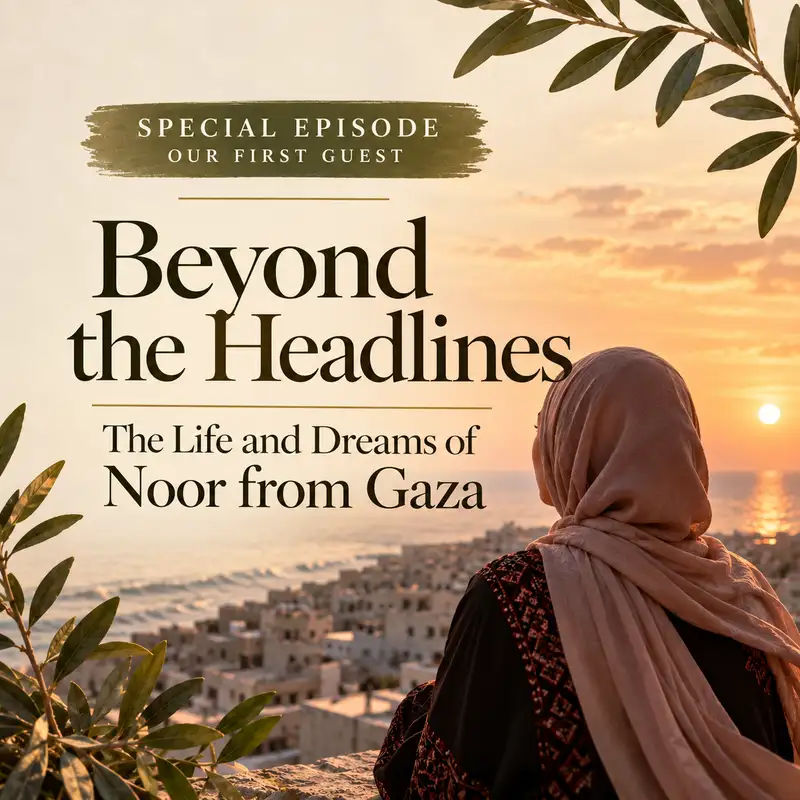
When we hear about places like Gaza, we so often hear numbers, statistics, headlines, and updates flashing across a screen. But behind every number is a person, someone with a childhood, a family, a home, and a future they were building. Today I want you to meet one of those people. Welcome to the House of Noor. I'm Mira, and today I'm joined by Noor, a 22-year-old writer from Gaza, whose words give us a personal window into real lives.
But before we talk about her writing, I want us to simply get to know her, the girl she was, the family she loves, and the woman she is today. Nora welcome, it's such a blessing having you here.
speaker-1 (00:57)
Thank you. Thank you for having me.
speaker-0 (01:00)
So Nora, before we talk about your writing or anything happening today, I would really love for our listeners to just get to know the little girl that you once were and what it was like growing up in Gaza.
speaker-1 (01:13)
⁓ okay, so I'm Noor and I'm twenty two years old. ⁓ born in Jabalia camp and I'm living now in Ashatia refugee camp. So all my life I spent it in camps. So my childhood was just like ⁓ a peaceful life actually and I was just like so happy and just like living l the life that every child deserved it. Alhamdulillah. especially that I was just like
⁓ me and my twin brother for my parents and we just like have had the life that like every child like should just like live it. Especially that my parents they were just like taking care about us and like the education, school and like other ⁓ enrolling us in other communities or like other centers related to just like trying to know our skills and our habits.
So they can help us to to know ourselves more and just like to practice the things that we love. So for me, ⁓ my mother was just like enrolling me on the ⁓ communities that just like for something related to art and music and like science labs. So just like she wanna discover me. So ⁓ at the end she discovered that I love literature and the ⁓ anything like related to reading and writing.
So ⁓ but like I wasn't ⁓ when I was child, I wasn't just like ⁓ writing. So I was just like reading box novels and ⁓ anything related to the ⁓ Palestinian literature. And ⁓ like I love box so and the stories, especially the children's stories. So yeah. And like at the age of like 19, I discovered that I can write and like I can publish my stories.
And I can like make people to hear my voice through through just like journaling or ⁓ sharing some stories that happened to me. So yeah, and just like I'm now twenty two years old and just like having articles published with different magazines and I have my zine also published around the world and like traveled around the world while me. I'm just like sitting here. So yeah, it's called waiting for the butterfly.
And yeah, ⁓ I'm so grateful actually. Yes.
speaker-0 (03:48)
That's that's amazing. ⁓ I remember we had discussed before this conversation that your favorite tradition was ⁓ you looking forward to eid and Ramadan. Could you touch base a little bit on that when you were a child growing up, what that was like for you?
speaker-1 (04:05)
Yes, Aidan Ramadan, they are like the best days and like Ramadan especially the fair my favorite month. So I love like on Ramadan to like try new recipes with my mother. I just like was saying to my mother that okay, we don't want to eat ⁓ traditional things or things that we used to eat, so we wanna try something new. So yeah, I used like to spend my days in the kitchen and just like trying to make recipes.
And like for my brother, he's he's just like he's my twin brother. So he was just like always arguing about these things. He he wasn't just like he don't like my food, so okay, so he can't eat. Okay. So yeah, it was just like like bitter on just like making the dessert, not like the food for like ⁓ the the normal food, you know? Yeah. ⁓ yeah, I was just like trying.
But like now I I feel like I reached the like a good stage now. Yeah. Yes. And like for Aid, Aid also is just like the best thing, like it filled with ⁓ visiting relatives and preparing our table like with putting like chocolates, cookies and like the coffee and like
speaker-0 (05:03)
He eats it now, huh?
speaker-1 (05:25)
The favorite the favorite like moment on the aid it's just like praying Al Fajr with ⁓ my family and then like listen to the ⁓ Dhhuat Takbirat and it was just like ⁓ filling my heart with peace and love, you know? Yeah. So yeah.
speaker-0 (05:47)
So for those of the list our listeners who don't know, ⁓ I am Muslim myself. ⁓ I practice Islam. So Fajr is morning prayer. But for those who aren't familiar, we only have two times we really celebrate during the year, which is Eid al-Fitr Eid al-Adha. And the big one is Eid al-Fitr. Am I correct? Well they're both pretty big, but
The one where we fast for the month of Ramadan. ⁓ and then in the end we celebrate ⁓ have a celebration of Eid, which is three days long. And so this is what you were just touching based on, because we don't celebrate like, you know, Christmas and growing up I used to celebrate all of those things before I reverted, but ⁓ it's an amazing time, very an amazing time to be celebrating with your family because of such a huge event where you like you said, you get all the chocolates and
You have all the family and everyone just comes together and you go from door to door and and so that's yeah.
speaker-1 (06:48)
like the vibes with like for me the vibes that I really like which is after like the boys of the family they all gather to go to visit like our aunt and like all of the ⁓ like they we call the Iliya Salat al Rahem. So they always go to visit like our aunts and the girls and then like after like in the afternoon we used just like to sit and eat our food and like watch movies and
⁓ talking about the days, what who like who they met and about the vibes on the street, how it was, especially if they were just like going to the south or like different places in the north here. So yeah, and especially also like after the war, like the transportations, it's getting hard. And going to different places is just like hard. So they are divided, going to
Like the people in this in the south in another day, which is not in the first day. So yeah. I guess ⁓ it's was it's just like I wish like like for Aid to come to war, you know. I love the box.
speaker-0 (07:57)
Yeah, it just feels pretty amazing. ⁓ you were an honor student ⁓ as a child and what did school mean to you growing up?
speaker-1 (08:09)
Yeah, school. It was just like meaning just like studying hard to get mo like high marks. And especially that my mother, she was just like focusing more on our education for me and my brother. And I was just like a ch like a like a child or a girl that used to
take like the high marks just like and determined of like doing the the special things, not not not taking the normal traits, you know. So it was hard also. It was affecting me that okay, you should you should study hard, you should focus more on the lessons and take notes and like study like not not like ⁓ ignoring the your study and just like, you know. So it was just like hard mentally. But at the same time I feel like it's it's just like the thing that made me no
like at this moment, you know? So yeah, and like in the high school, I ⁓ I discovered like all of the all of the years was just the elementary school and ⁓ the middle school. It was just like I discovered them like on the high school or just like ⁓ it helped me to like to know more about my lesson and just like to be like to take a a high grade. So especially that I get 92.7% at the high school.
So yeah.
speaker-0 (09:38)
When we spoke before, one of the things that had stood out to me was how much you value your education and how many dreams you had for your future. ⁓ when you were younger, what did you imagine your life would look like at the age of twenty two?
speaker-1 (09:53)
Yeah, when I was young, I was just like imagining myself to ⁓ like to study the major that I studied. especially that was just like ⁓ like I was seeing my father as an accountant. He was just like ⁓ teaching at ⁓ a college here and he used also to work on an accountant department on the companies. So I was just like love the way of like the like the leadership and the management field and just like
delving deeper in it and talking with my father, discussing about like those things. So I was just like saying, okay, I will be just like studying this measure. I love it. So I did that actually and I studied leadership on my ⁓ last year at high school and I got the the average that I mentioned and also I delved deeper on it on the ⁓ bachelor degree and my bachelor degree it was like business administration but I studied in English.
So yeah, and I re I feel like it was good to choose this and I'm really grateful that because j just like I'm thinking to also pursue masters on the international businesses. Yeah. So yeah.
speaker-0 (11:10)
Did you always imagine going to university? I know you had mentioned wanting to study in London.
speaker-1 (11:15)
Yeah, I I hope I can do it. Just like ⁓ as I mentioned to you, I I as I told you, ⁓ I'm just like filling applications for like ⁓ scholarships and also I'm applying for ⁓ like different universities. And I also have an offer from ⁓ a university in London, which is Goldismith is. And I hope I can make it to London by like September twenty seven twenty two hundred like two thousand twenty seven. So
speaker-0 (11:43)
You said that ⁓ when you had a higher education that it was easier for you to evacuate out of Gaza? Is that what you
speaker-1 (11:50)
⁓ it's just like if you have a fully funded scholarship, you can be evacuated easily from the empatsies. So it's gonna be like it's not like a hard process. So the universities they're gonna coordinate for you.
speaker-0 (12:06)
Okay. It's interesting how we all grow up imagining the lives that we were going to have. And sometimes we picture, you know, where we're all going to study and what careers we want to pursue or where we're going to travel to without knowing how much of our circumstances just may change. ⁓ we have talked a little bit about your childhood and the life you had imagined for yourself. Now I'd like to talk about what life looks like for you today if you're comfortable sharing. For those of us listening from other parts of the world.
What is everyday life like for you and your family in Gaza right now?
speaker-1 (12:42)
Okay, life in Gaza now it's hard. especially like ⁓ okay, let us just like say there's no ceasefire right now. So we are just like getting bombed and like the ⁓ everything just like entering Gaza which is goods or food or anything, it's just like you know, it's just like ⁓ little things and it's not like
for like like fitting the people who lived or survived a starvation. So and also on the other side, living in a tents for people who lost their homes, it's hard. Especially like it's can't it can't save you from ⁓ anything, from rain and like from a pump and so it's hard for like for all of us, like in different ways.
So if I just like wanna talk, I will just like have I should I should have two days to talk about all of the struggles and the hardships that's happening. So yeah, it's just like kinda like it's not finishing.
speaker-0 (13:51)
Yeah. In the in the midst of everything happening around you, what are the little things that still bring you comfort or help you feel connected with others around you or family?
speaker-1 (14:05)
Actually, like for me I used like these days to go to the pitch with my friends. It's just like the space that I feel I'm comfortable and like I can't see destruction there. I just like can see the colour and the sun and the sunset. So it just like can help me to like heal and at the same time to process the things that it's happening and just like to be far from the destruction and like everything that it's
⁓ like surrounding us with the the the ugly things, you know. So ⁓ and also writing it's like helping me more also to just like express my feelings and like to share what is the things that it's just like hurting me and also like shedding light on some issues that's happening here on the ground, like sharing it with the people outside. So yeah, I guess those two things it's just like helping me more.
These states.
speaker-0 (15:05)
That's really amazing that you have a place you can go. I know sitting at the beach is something amazing to do. And like you said, you can't see any destruction, but you can just hear the peacefulness of the of the waves, you know. what what is something about everyday life in Gaza that you wish people outside understood better, like people like me and across the world?
speaker-1 (15:32)
I would just like ⁓ tell the people outside to know how like hard like this life turned to be after this war, especially after this genocide, three years of genocide. So it just like killed everything in this ⁓ in this city. It was just like a city full of life and at the like it at in two hundred and in two thousand twenty-three
We reached the point just like everything is available here. And ⁓ all of the people they are rebuilding their home, redecorating it, they are opening their shops, their businesses. So it was just like the life that okay, no one is ⁓ it's just like thinking to leave it, to leave this city, you know? And people they were just like coming, you know. So now it's just like turned out to be an like a city which is like filled with destruction.
filled with everything is just like making you to feel more upset about the ⁓ like the life and like it's just like like you know no there is no universities now like people or students they are studying online so and schools also turn to be a shelters and ⁓ like everything is just like turning to be more just like
hard for the people they are living it and just like so I don't know how to say it, but it's just like too hard. Yeah.
speaker-0 (17:06)
So for those who have never traveled or visited Gaza, what is something that you would like for us to know about the people who who live there? What are you what are you all like? Are you, you know, how how are you how are the people there?
speaker-1 (17:21)
Yeah, okay. People here, they are just like so generous actually. Yeah. And like the places that like you will see here, it's just like like before this genocide. It was just like so beautiful, especially the old city here in Gaza. It was ⁓ an old building there, which is Al Amari Mosque. They bombed it ⁓ during the war. And there was also they called it Hamamas Samra.
which is the place that was just like very, very old. And there was ⁓ museum here also. It called Kasril Basha. So there was ⁓ like these like these places was just like having ⁓ so many old like details and from like the ⁓ like from the old centuries, you know. So just like old turned to be just like a ruple now. So
I wish just like the people to know also that this city is just like a like the a city will you like you will feel yourself like happy when you are walking on the streets, you know? Yeah. So and also especially the beach, like our beach is really beautiful. So yeah. I guess that's it.
speaker-0 (18:38)
Yeah. You are also a writer with ⁓ organization called We Are Not Numbers. I think the name itself carries such an important message message, especially after everything we've talked about today. So for listeners who may not be familiar with the organization, can you tell us a little bit about what it does and how you became involved?
speaker-1 (18:58)
Okay, ⁓ we are not numbers, it's ⁓ a community for writers. like that writers from ⁓ from Gaza and I guess from around the world. So ⁓ those writers they can express about everything that's happening in their life, especially for the the writers in Gazza, they can shed light on some issues that's happening in Gaza to tell the people how they are living and what is happening. So and ⁓
It also just like can help us to get like to know to have more opportunities like to connect with different people, to talk like for me, I I just like now connected with youth. So like to talk and to share my story with you. So yeah, it's a beautiful place and a beautiful community to be in. And I'm just like so grateful for like to be a w one of the wanners. So yeah.
speaker-0 (19:52)
How does it feel knowing that people in other countries may read your words and and learn about life through your experiences?
speaker-1 (20:00)
It's so it's so just like it's something like keep me comfortable that people are hearing me and just like know what I'm living. So and it's just like kind of like you are just like people are seeing you and they know what what you are like endured and what you are still experiencing. So ⁓ yeah, I feel like comfortable with just like sharing about the things and it make me so happy actually. Yeah.
speaker-0 (20:29)
I read your article, Invisible Heroes, Children Beseeched by War. And one of the things that stayed with me was the way you describe children expressing their memories and experiences through drawings. Now, as a mother myself, I think of just how much children carry inside them and that they sometimes don't have the words to explain. So would you be able to tell us a little bit about the children that you worked with and what those experiences have been like for you?
speaker-1 (20:55)
Yeah, ⁓ I remember for like this article, it was ⁓ it was my first experience to just like share like the words of the children outside and also to to sit with the children and just like to know more about their ⁓ what they are living and the things that it's just like ⁓ like affected them after this war. Yeah. So ⁓
The story of this article was when I was sitting on my camp and ⁓ I was just like seeing the children ⁓ there they are like going to the lung cues just like to fill their water or like to take food to their families. And they are like they were just like living ⁓ things that it's just like above their age. So I decided to make just like a small space in my tent to just like sit with the ⁓ the children and just like talk.
And maybe drawing about the things that they are living or the things that they wish to be and they wish to happen. So some of them they draw like Iman, she drew her ⁓ like her school, how it was and how she was how she was going to the school and the bus, waiting for the bus. And then the other side she drew a tent while she is living in it. And there's also as she drew ⁓ like the way.
going back to home while like everywhere there is destruction. So it was just like things that it's just like hard for them. And at the same time I realized that we all like having those like scenes in our in our memory and just like living at the same the same thing which is like ⁓ we are not accepting this reality and at the same time we wish to go back. Especially that it was just like
⁓ it was in the south and we were displaced in a tent. So it was hard with accepting this after we was just like living in a in our homes. there is walls protecting us and just like we are living a normal life. So it was hard for them to accepting this. And I tried my best actually. I tried my best to just like make them express their feelings and like to share their stories with the world. So I f I I feel like
I wish I wish like to I achieved with like I succeeded with like sharing this and like making people to know about what they are living.
speaker-0 (23:32)
Yeah. Speaking of which, what do you hope we understand after you're writing that invisible heroes, if s if they read invisible h invisible heroes, which I'm gonna post in the comments, ⁓ the show notes below for them to get to? What is what are some things that you hope that we get from this that we take away from reading this article?
speaker-1 (23:53)
Yeah, it was just like for people to know that these the children of Gaza, they ⁓ like they felt really harsh times. And ⁓ especially like for the children who were just like raised in tents, so ⁓ their age was just like the age of the war. So it's so hard. Especially that they were just like ⁓ creating memories at this age.
So she she so they created ⁓ hard memories for them. So they deserve a better life. And ⁓ I remember like there was ⁓ a girl called Wadiz, she mentioned a quote at the ⁓ I I wrote it on my article. She was just like saying, like do the do the people or the children of like of the other world, the like the world outside, they are living at the same ⁓ life with
like that like us. So it was just like ⁓ her coat was like was just like hitting me differently, you know. So it was hard. So for them and especially like for me, I lived my childhood and there was like ⁓ like ⁓ good memories. So for them they are living in tents. So yeah, I hope like I tried I tried to like take these things from them and just like to share it with the world. Like and they got they got the point of this article.
speaker-0 (25:20)
Yeah. Some sometimes adults assume children don't fully understand what's happening around them. But being a mother of seven children, I can tell you that they notice and absorb everything and so much more than what we realize. ⁓ so earlier we talked about the dreams that you had growing up, especially your education in the future that you have had imagined for yourself. When you look ahead now.
What are some of the things you're still hoping to experience or accomplish?
speaker-1 (25:55)
Okay, for me, like as I mentioned, I wish like I can travel from here just like to finish my masters and then then like discovering the world outside. ⁓ and I hope like I can like for like maybe ⁓ like I can book a plan and just like to to see the world from like a pole. And I really like hope this like can could be achieved.
And ⁓ I hope I can achieve my dream, which is like my my big goal now, just like to pursue this master in London. So yeah.
speaker-0 (26:34)
All of this will happen for you, yeah.
speaker-1 (26:36)
We hope so.
speaker-0 (26:38)
Do you still hope to study business leadership abroad or is there anything different that you're wanting to do on top of that or?
speaker-1 (26:46)
Okay. I've actually was just like ⁓ interested in studying marketing and consumer behavior and also international businesses. So I'm just like trying just like I didn't decide yet, but it depends on the scholarship or the like the offer that I will be receiving. So yeah, now we will just like see this in the next. Yeah. So ⁓ yeah.
speaker-0 (27:12)
When you imagine the next chapter of your life, what would that look like to you?
speaker-1 (27:18)
⁓ okay, I said it it's just like I wanna I wanna go outside and just like to be evacuated from here. so I can just like achieve my dreams and like to see the world, how it just like people outside they are living and yeah, just like discover this earth, you know. Yeah.
speaker-0 (27:41)
Well, Nora, we've spent this time getting to know you and hearing about your childhood dreams, your writing, and your life today. And before we finish, there's one last question that I would really love to ask you. And that is for everyone who is listening to our conversation, what is the one thing you hope they take away from hearing your story today?
speaker-1 (28:01)
Yeah, okay. I want just like the world to know that we like deserve a better life. And like I just like have one wish which is like for all of like to to to to erase like all of the tents in this world and just like make all of the people they are living in tent to live in a home in the in their houses. And that because like it's so hard, especially if I like especially that I experienced
this like I lived in a tent for seven months and I experienced the summer in it and the winter. So yeah and also like we like deserve like a thing which is like the peace you know and like living in a normal life without any pumps and without any plane like hovering above our heads and without the fear of like the or the trauma. So
Yeah, I guess that's it.
speaker-0 (29:04)
Noor, thank you so much for joining me today on the House of Noor. It has been such a pleasure getting to know you and hearing your story. And I truly appreciate you taking the time to share your memories, your experiences, and your hopes for the future with us. Thank you so much for being here.
speaker-1 (29:21)
Thank you. Thank you for having me. And it was just like
speaker-0 (29:24)
It was a pleasure. At the beginning of today's episode, I talked about how easy it can be to see people through headlines and numbers. But today we got to know Nor. We heard about her childhood, her family, her education, her writing, and the dreams she carries for her future. And I hope that when we hear about people living in places far from our own, we remember that there's always so much more to their lives than the circumstances we see on the news.
There are memories, families, ambitions, traditions, and stories that deserve to be heard. Getting emotional. If you'd like to read Noor's work, I've included a link in her artic to her article, Invisible Heroes Children Besieged by War, along with more information about We Are Not Numbers in the episode notes. Thank you for spending this time with us on the House of Noor. Until next time, take care of yourselves and one another.